Candidate’s Name: Zulayka
Adamson
Grade Level: Kindergarten
Title of the lesson: Reading
Activity on seasons
Length of the lesson: 50 Minutes
|
Central focus of the lesson : Students will participate in a
read-along about the 4 seasons. Students will be able to identify key terms
and activities associated with the various seasons and learn how to compare
and contrast two seasons.
|
|
Knowledge of students to inform
teaching (prior knowledge/prerequisite skills and personal/cultural/community
assets)
● Students are familiar with basic weather
patterns, i.e. rain, snow and sunshine.
●
Students use their past experiences as a reference to
weather and the text.
|
|
Common Core State Standards
(List the number and text of the standard. If only a portion of a standard is
being addressed, then only list the relevant part[s].)
With
prompting and support, describe the connection between two individuals, events,
ideas, or pieces of information in a text.
With
prompting and support, ask and answer questions about unknown words in a
text.
With
prompting and support, describe the relationship between illustrations and
the text in which they appear (e.g., what person, place, thing, or idea in
the text an illustration depicts).
Use a combination of drawing, dictating, and writing to
compose opinion pieces in which they tell a reader the topic or the name of
the book they are writing about and state an opinion or preference about the
topic or book (e.g., My favorite book
is...)
|
|
Support literacy development
through language (academic language)
● Students will compose a
letter to a friend describing which season is their favorite based on some of
the highlighted components referenced in the book.
● Students will present an oral presentation
and share with the class which season is the best.
Vocabulary
● Students will analyze the text by
highlighting some words that may decode which season is presented in the
book.
● Content specific vocabulary (winter,
spring, fall, summer, cold, breeze, sunny, beach, park, flowers )
Sentence
Level
●Students will write 2
sentences using the correct tenses and some of the words identified in the
text.
Discourse
● Students are already familiar with
various weather patterns which they highlight everyday during the morning
meeting, they will get an in depth exploration of how this correlates to the
season.
|
|
Learning objectives
Sample:
1. Students will decode the correct season
based on the sentences and
information
provided in the text.
2. Students will be able to compare and
contrast two seasons.
3. Will be able support their opinions on
seasons with key details from the text.
|
|
Formal and informal assessment
(including type[s] of assessment and what is being assessed)
●
Oral Presentation
●
Written Component
●
Compare and Contrast
|
|
Instructional procedure:
Instructional strategies and learning tasks (including what you and the students
will be doing) that support diverse student needs. Your design should be
based on the following:
Students will participate in a
read-along with their classmates. (15 min)
Students will watch a brief
video on four seasons. (5 min)
Students will participate in a
brief group discussion. (10 min)
Students will write and
present their letter to their friend on their favorite season. (20 min)
Accommodations and
Modifications: ELLs/struggling readers will have an added visual component to
connect the lesson plan.
|
|
Instructional resources and
materials used to engage students in learning.
●
|
|
Reflection
By incorporating the BrainPop
video, ELLs and struggling readers had an additional resource to provide
background information on the four seasons. The discussion and oral
presentation sharpens students writing and oral skills.
|
Rubric
|
1
|
2
|
3
|
Score
|
|
Student
doesn’t begin their sentences work with capitalize letter.
|
Student
begins some sentences with capitalized letters.
|
Student
begins all sentences with capitalized letters.
|
|
|
Student
doesn’t end sentences with punctuations.
|
Student
ends some sentences with punctuations.
|
Student
ends all sentences with punctuations.
|
|
|
Student
doesn’t participate in oral presentation.
|
Student
presents letter low.
|
Student
presents letter clearly.
|
|
|
Student
doesn’t participate in group discussion.
|
Student
participates for only one part of the discussion.
|
Student
participates in all group discussions.
|
|
Total Points:
Candidate’s Name: Zulayka
Adamson
Grade Level: Kindergarten
Title of the lesson: Science:
Weather Outside
Length of the lesson: 45 Minutes
|
Central focus of the lesson : Students will learn how to use a
thermometer and make connections to the weather.
|
|
Knowledge of students to
inform teaching (prior knowledge/prerequisite skills and
personal/cultural/community assets)
● Students are familiar with the four
seasons through a previous lesson plan.
|
|
Common Core State Standards
(List the number and text of the standard. If only a portion of a standard is
being addressed, then only list the relevant part[s].)
With
prompting and support, describe the connection between two individuals,
events, ideas, or pieces of information in a text.
Actively
engage in group reading activities with purpose and understanding.
Describe
familiar people, places, things, and events and, with prompting and support,
provide additional detail.
|
|
Support literacy development
through language (academic language)
● Students will learn how to
read a thermometer and record the degrees.
Vocabulary
● Students will analyze the text by
highlighting some words that may decode which season is presented in the
book.
● Content specific vocabulary (degrees,
thermometer, ones, tens)
Sentence
Level
●Students learn to measure
cold and hot items with a thermometer and break out into stations for each
season and pick the appropriate attire for the season.
Discourse
● Students who experience difficulty with
the concept of seasons with have an interactive station that provides
students a visual aid (clothing) to connect to the weather and degrees.
|
|
Learning objectives
Sample:
1. Students will decode the correct season
based on the thermometer exercise.
2. Students will learn the relationship of
seasons in regard to degrees.
3. Will be able support their clothing
attire selections based off of scientific findings.
|
|
Formal and informal assessment
(including type[s] of assessment and what is being assessed)
●
Students will have a cup of warm water and cold water
to evaluate the use of thermometers.
●
Students will use a worksheet to record their
findings through the thermometer.
|
|
Instructional procedure:
Instructional strategies and learning tasks (including what you and the
students will be doing) that support diverse student needs. Your design
should be based on the following:
Students will participate in
an experiment with the teacher to learn about temperature(12 min)
Students will rotate to each
station and work in groups to determine the season based on the attire at the
table. (38 min)
Accommodations and
Modifications: Teacher's assistant will rotate around the room to ensure
students are staying on task and haven’t run into any difficulties.
|
|
Instructional resources and
materials used to engage students in learning.
● https://s-media-cache-ak0.pinimg.com/236x/0e/94/46/0e94466868a2931a561784912d6acab8.jpg
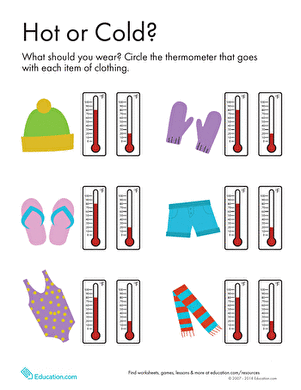
● Homework:https://cdn.education.com/worksheet-image/125164/temperature-hot-cold-physical-science.png
● Gloves, hat, scarf, flip flops, sunglasses, short sleeve shirt,
sweater and heavy jacket
|
|
Reflection
By incorporating a hands on experiment,
students will have a visual and an activity that they may reference when
determining the appropriate weather in each station. This hands on assignment
is part of the full scope of the Season Thematic unit.
|
Rubric
|
1
|
2
|
3
|
Score
|
|
Student
shows limited skills in reading thermometer
|
Student
comprehends limited understanding of thermometers
|
Student
understands concept of thermometers.
|
|
|
Student
unable to decode key weather terms.
|
Student
decodes some key weather terms.
|
Student
decodes all key weather terms.
|
|
|
Student
doesn’t understand the concept of degrees and seasons.
|
Student
understand some of the concept of degrees and seasons.
|
Student
understands the concept of degrees and seasons.
|
|
Total Points:
Candidate’s Name: Zulayka
Adamson
Grade Level: Kindergarten
Title of the lesson: Math
Activity on seasons
Length of the lesson: 50 Minutes
|
Central focus of the lesson : Students will learn how to identify
their one’s.
|
|
Knowledge of students to
inform teaching (prior knowledge/prerequisite skills and
personal/cultural/community assets)
● Students are familiar with the numeric
system.
●
Students use their previous knowledge of the weather
to answer the weather worksheet.
|
|
Common Core State Standards
(List the number and text of the standard. If only a portion of a standard is
being addressed, then only list the relevant part[s].)
Write
numbers from 0 to 20. Represent a number of objects with a written numeral
0-20 (with 0 representing a count of no objects).
Understand the relationship between numbers and
quantities; connect counting to cardinality.
|
|
Support literacy development
through language (academic language)
● Students will recite the
numbers 1-20 and identify numbers listed on the board.
● Students will utilize their addition
skills to add objects.
Vocabulary
● Students will identify numbers on the
number charts.
● Content specific vocabulary (add, ones,
1-20)
Discourse
● Students are familiar with the numeric
concept, they are able to practice their number identity and counting method.
|
|
Learning objectives
Sample:
1. Students will be able to count and add
weather objects.
2. Students will be able to count to 20 in
written format.
|
|
Formal and informal assessment
(including type[s] of assessment and what is being assessed)
●
Students will recite the number charts as a group for
1-20.
●
Students will complete two worksheets as a practice
on their numeric understanding.
|
|
Instructional procedure:
Instructional strategies and learning tasks (including what you and the
students will be doing) that support diverse student needs. Your design
should be based on the following:
Students will participate in
counting numbers classmates. (15 min)
Students will watch a brief
video on basic adding. (5 min)
Students will work on a
worksheet. (20 min)
Accommodations and
Modifications: ELLs/struggling readers will have an added visual component to
connect the lesson plan.
|
|
Instructional resources and
materials used to engage students in learning.
●
|
|
Reflection
By incorporating the BrainPop
video, ELLs and struggling readers had an additional resource to provide
extensive concept on adding. The worksheet serves as a formal assessment of
students learning habits.
|
Rubric
|
1
|
2
|
3
|
Score
|
|
Student
doesn’t understand the concept of one’s.
|
Student
knows some of the numbers.
|
Student can
identify all of the numbers.
|
|
|
Student
doesn’t know how to read the number chart.
|
Student
able to read a portion of the number chart.
|
Student
knows all the numbers on the number chart.
|
|
|
Student has
3 or more problems incorrect.
|
Student has
2 problems incorrect.
|
Student has
no errors on worksheet.
|
|
Total Points:
Candidate’s Name: Zulayka
Adamson
Grade Level: Kindergarten
Title of the lesson: Social
Studies Activity on Their Community
Length of the lesson: 50 Minutes
|
Central focus of the lesson : Students will learn share with the
group about where they are from and what is the typical weather like during
this time of the year.
|
|
Knowledge of students to
inform teaching (prior knowledge/prerequisite skills and
personal/cultural/community assets)
● Students who are from different
backgrounds or community are able to share with their classmates what is like
during this time of year where they are from.
|
|
Common Core State Standards
(List the number and text of the standard. If only a portion of a standard is
being addressed, then only list the relevant part[s].)
With
guidance and support from adults, respond to questions and suggestions from
peers and add details to strengthen writing as needed.
With guidance and support from adults, recall
information from experiences or gather information from provided sources to
answer a question.
|
|
Support literacy development
through language (academic language)
● Students will read along to
the story “Same Same but different”.
Students will then have a
discussion on what communities are.
●
Students will write a three sentences about where
they are from (community) and what the weather is typically like this time of
year.
Vocabulary
● Community, Weather, like and about
Discourse
● Students are familiar with the concept
of weather, however, they will have to connect the weather and what their
community is like.
|
|
Learning objectives
Sample:
1.
Students will
identify what makes a community.
2. Students will be able to write about
their community.
|
|
Formal and informal assessment
(including type[s] of assessment and what is being assessed)
●
Students will read along to “Same Same but different”
to learn about how there are different cultures.
●
After reading about the cultures, students will write
about their community.
|
|
Instructional procedure:
Instructional strategies and learning tasks (including what you and the
students will be doing) that support diverse student needs. Your design
should be based on the following:
Students will read along. (15
min)
Students will watch a video on
communities. (5 min)
Students will have a
discussion on what their communities means to them. (10 min)
Students will write about
their communities using key terms highlighted in the story. (20 min)
Accommodations and
Modifications: ELLs/struggling readers will feel a sense of comfort as they
are able to highlight their respective cultures and customs. By having a read
along and group discussion, ELLs and struggling learners have 3 portions of
the lesson plan that expands on community.
|
|
Instructional resources and
materials used to engage students in learning.
|
|
Reflection
By incorporating a video, read
along and a discussion, students of all learning levels will feel comfortable
working on this topic. Students who are ELLs are able to share their special
cultural customs and feel a sense of inclusion.
|
Rubric
|
1
|
2
|
3
|
Score
|
|
Student
doesn’t understand the concept of community
|
Student to
give an explanation of community.
|
Student is
able to give a complete description of community.
|
|
|
Student
doesn’t begins sentence with capital letters.
|
Student
begins some sentences with capital letters.
|
Student
begins all sentences with capital letters.
|
|
|
Student
doesn’t end sentences with
punctuations.
|
Student
ends some sentences with punctuations.
|
Student all
sentences with punctuations.
|
|
|
Student
doesn’t participate in group discussion.
|
Student
participate in a portion of the group discussion.
|
Student
participate in all portions of the group discussion.
|
|
Total Points: